NVIDIA announces Blackwell Ultra and Dynamo inference software
NVIDIA announced Blackwell Ultra, including the GB300 NVL72 and HGX B300 NVL16 systems, alongside NVIDIA Dynamo open-source inference software.
By Hypler editorial team · Source: NVIDIA.
Original source date: .
Hypler publication: . Hypler updated: .
Estimated reading time: 4 minutes.
Topics: NVIDIA, Blackwell, inference, reasoning

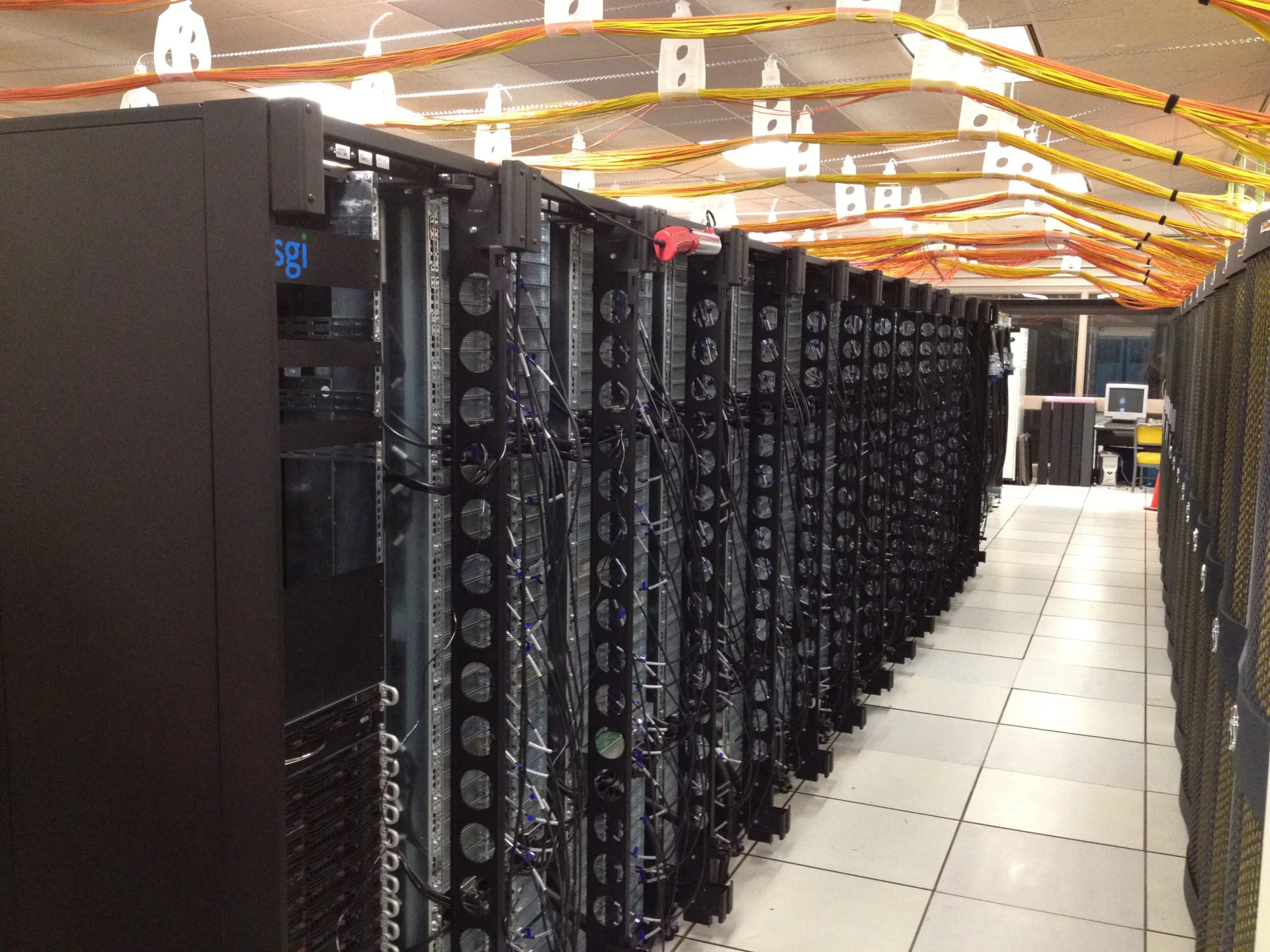
The announcement described a scale-out stack
At GTC on March 18, 2025, NVIDIA announced Blackwell Ultra alongside NVIDIA Dynamo in a release about training and test-time inference for reasoning, agentic, and physical-AI workloads. It named the GB300 NVL72 rack-scale system and HGX B300 NVL16 system, plus Spectrum-X and Quantum-X800 networking. NVIDIA described Dynamo as open-source inference-serving software for large GPU fleets, including disaggregated serving that separates processing and generation phases onto different GPUs. The release said partner products were expected from the second half of 2025. Those are announcement records, not deployment measurements.
Reasoning reshapes the capacity question
A user's experience depends on queue delay, time to first token, generation rate, context size, tool waits, retries, and concurrent work. Hardware is one layer in that result. A useful operating record names the model, prompt-length distribution, output budget, tool policy, serving engine, routing configuration, hardware, and traffic mix behind every observation. A short interactive question and a long research task can use the same model in radically different ways. Admission controls, cancellation, quotas, timeouts, and priority rules belong beside the configuration because they determine whose work waits when demand grows.
The queue is part of the product promise
Consider a hypothetical engineering-review assistant restricted to a named repository revision and file set. Each request has a token budget, deadline, and stable identifier, and may return a cited review draft. It cannot widen the file set, open a deployment action, or reuse prior approval. The controller measures queue time separately from execution. A task that misses its deadline becomes explicitly incomplete, retaining inputs and partial output for review. After worker loss, recovery resumes only from an idempotent checkpoint. This makes capacity a real product decision: the team can decide which requests deserve rapid response.
Disaggregation still needs an observable request path
Separate request, control, and state paths. One accepts validated work and returns results; another manages placement, scaling, quotas, and health; a third keeps task identity, cache references, retry count, and outcome. NVIDIA's disaggregated-serving description offers a performance approach, while a deployment still must assign ownership for each path. Observability should connect the user request to admission, model selection, worker assignment, tool calls, cache behavior, and terminal state. Preserve bounded fields such as input-size band and terminal reason rather than treating private prompts and outputs as default telemetry.
Throughput can disguise a poor user experience
Aggregate throughput can look healthy while short requests sit behind long ones. Cache reuse can improve a representative test while helping little with variable prompts. Over-packing workers can create tail-latency spikes; under-packing wastes capacity. Network contention, worker failure, and an upstream tool wait can all resemble silence to the requester. Mix short and long tasks, exhaust the queue, cancel work during generation, inject worker loss, and replay an ambiguous timeout. Inspect whether the service returns one terminal state, prevents duplicate work, and tells the person who submitted it what occurred.
Workload proof is more useful than a slogan
Build evaluation classes from short questions, long-context analysis, structured extraction, tool-assisted work, and cancellation. For each, retain concurrency, input and output distributions, queue delay, first-token latency, completion latency, error rate, and cost basis. Keep the model, engine, routing configuration, and hardware description with each result. Before expansion, define acceptable waiting, overload behavior, rollback, and the incident owner. A controlled load test and recovery test can then be compared with a known baseline instead of becoming a one-time performance display.
The decision remains operational
Hypler treats NVIDIA's release as a historical description of systems and software, not proof that a particular reasoning service meets a particular objective. Review model, engine, cache policy, networking, and autoscaling separately after each relevant change. The practical result should be a decision record for a defined workload under stated conditions, including how the service fails and recovers. That record is more useful to operators than a headline claim because it describes the service people actually receive.
Hypler analysis
Hypler’s view
Reasoning capacity is a user-facing contract. A hardware announcement matters less than the measured behavior of a named model, serving stack, queue policy, and workload when demand spikes or a component fails.
Hypler technical analysis
Engineering notes
Reasoning and agent workloads expose a coupled serving path: model memory demand, batch and queue policy, accelerator topology, network transport, and output-token behavior jointly determine latency and capacity. Hardware announcements and selected generation comparisons are useful planning inputs only when tied to a defined workload and serving configuration.
What to inspect
- Workload trace
- Capture model target, prompt and output distributions, concurrency, tool-wait behavior, context size, and quality threshold before drawing capacity conclusions.
- Serving topology
- Inspect accelerator configuration, memory allocation, inference software revision, batching policy, queue limits, and network path used for the measured request.
- Latency decomposition
- Measure queue time, prefill, generation, network transfer, and tool waits separately; inspect tail behavior during burst traffic and retry conditions.
Scope and limits. The vendor release reports selected platform comparisons. It does not supply a workload-neutral throughput promise or prove performance for another model, deployment, request mix, or operating constraint.
Terms and definitions
- GPU
- Graphics processing unit: a processor designed for highly parallel computation, commonly used for AI training and inference.
- Inference
- Using a trained model to produce an output from new input.
- Memory Bandwidth
- The rate at which a processor can read from or write to memory.
- Power Capacity
- The electrical power a facility or system can safely supply to equipment.
- NVIDIA commits UK compute access for agentic safety and security research
NVIDIA says it will commit UK-hosted compute access valued at $250 million across five years for agentic safety and security research.
- OpenAI releases gpt-oss open-weight reasoning models
OpenAI released gpt-oss-120b and gpt-oss-20b Apache 2.0 open-weight reasoning models with deployment references and malicious fine-tuning safety work.
- NVIDIA introduces the AI Data Platform reference design
NVIDIA announced the NVIDIA AI Data Platform, a reference design for storage providers building infrastructure for AI inference and data-query agents.
Original source
Historical source briefing with Hypler engineering analysis. Source details reflect the original publication date; implementation examples are hypothetical. Technical analysis expanded October 24, 2026; this does not change the original source event or establish a new source verification. Editorial prose revised October 26, 2026; original event, publication and source-check dates are retained.