Google introduces Gemma 3
Google introduced Gemma 3 open models with stated sizes, supported multimodal capability, 128K context, function calling, deployment options, and safety work.
By Hypler editorial team · Source: Google.
Original source date: .
Hypler publication: . Hypler updated: .
Estimated reading time: 4 minutes.
Topics: Google, open models, deployment

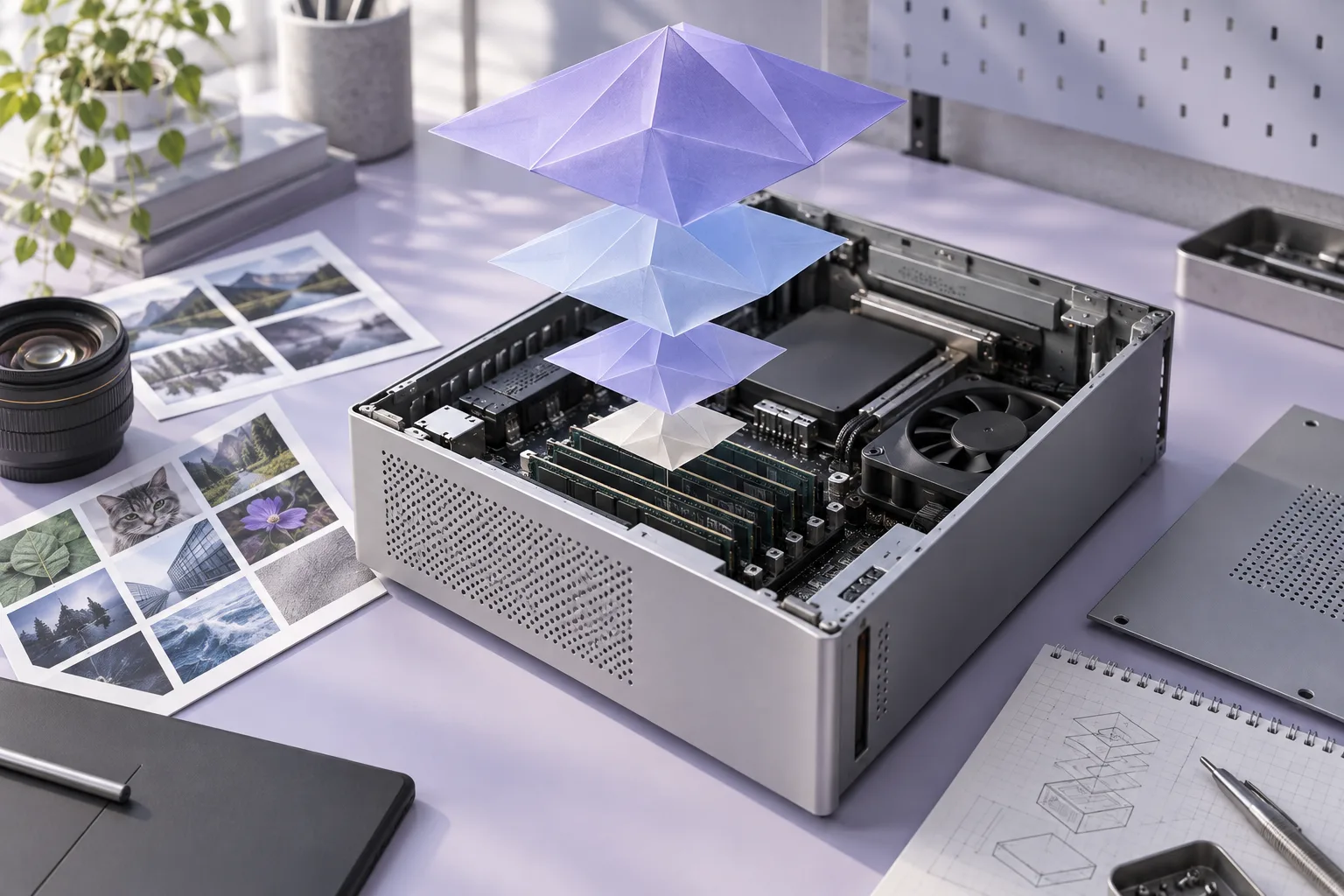
Open weights move responsibility into the operating team
Google’s March 12, 2025 announcement introduced Gemma 3 models based on Gemini 2.0 technology in several sizes. It described multimodal support for supported sizes, a 128K-token context window, function calling, quantized variants and deployment options. Hardware and benchmark claims are vendor statements under the release’s stated conditions. The launch does not make every size image-capable or every runtime equivalent. It gives an adopter more deployment choices, while moving responsibility for artifact identity, licensing, capacity, data handling, safety configuration, upgrades and recovery into the service that operates the model.
The deployment contract starts with the exact artifact
A local route should retain model revision, license review, conversion or quantization step, tokenizer and prompt format, accelerator runtime, input limits, output schema, filters, telemetry, rollback image and patch process. Its endpoint can expose model revision and capability boundaries instead of imitating a cloud API without disclosure. A downloadable model can still depend on software, components or distribution rules that affect the application. A reproducible manifest lets another engineer rebuild the route and assess its terms. Open availability does not automatically mean unrestricted use, identical behavior, or a solved privacy boundary.
Hardware admission is a service decision
Weights, working state, input processing and concurrent requests compete with the host’s other work. Establish memory allowance and queue limits, then measure the selected configuration under realistic contention. An Apple Silicon route and an x86 CPU route may need different serving choices and concurrency policies; acceleration should be measured rather than inferred from a machine name. Quantization can change task quality, and long context can conceal retrieval failure. The adapter should surface cancellation, unavailable capacity and interruption as explicit outcomes so a user can wait, reduce a request or choose an approved alternative without silent retry loops.
Multimodal inputs keep their own lifecycle
An image may need normalization, size limits and permission checks before it reaches a multimodal model. The admitted asset should remain connected to the result without unnecessary copies in logs or caches. A response about an image must not become an authoritative database update without application validation. Local inference changes where a computation runs, not who owns records or which actions the user authorized. The same is true for text. Portability is valuable when it preserves application boundaries rather than replacing them with runtime-specific prompt conventions that are difficult to inspect or migrate.
A classifier pilot makes the runtime observable
In a hypothetical manufacturer pilot, an isolated service accepts only approved PDF text extraction and returns a typed category with confidence. It stores no raw prompt by default and exposes a health endpoint naming the exact model digest. Low-confidence records move to a human queue rather than an automatic disposition. The example narrows the question from whether an open model is broadly capable to whether a particular artifact, runtime and workload meet defined acceptance criteria. That is the level at which license, throughput, safety and recovery decisions can be meaningfully reviewed.
The tested route is the claim that matters
Run representative fixtures across hardware, quantization, language, document length, overload, unsupported assets, process restarts and cancellations. Verify model hashes at startup, schema errors at the boundary, resource exhaustion behavior and rollback to the previous image. Record peak memory, queue wait, completion time and task quality against the exact artifact and host configuration. Hypler’s judgment is that a local model can be a bounded, replaceable component in an SI system. Gemma 3’s release does not demonstrate autonomous or superhuman operations; it invites disciplined evidence for a defined runtime. Each claimed advantage should remain attached to observed results, a known configuration, and an explicit owner for operating it.
Hypler analysis
Hypler’s view
Open-model deployment shifts operational responsibility to the adopter. Hypler’s analysis validates license, artifact provenance, hardware fit, safety settings, updates, and observability for the precise runtime rather than relying on an open-weights label.
Hypler technical analysis
Engineering notes
Open-model deployment shifts responsibility from a vendor-hosted API toward the operator's serving stack. Model size, supported multimodal input, long context, function calling, hardware claims, and safety work are inputs to a deployment design, but the deployed artifact also needs a verified weight source, licensing record, runtime configuration, access control, update path, and observability. A compatible machine is only one component; the system must prove which model and settings produced a given result.
What to inspect
- Provenance record
- Inspect the model artifact identifier, license review, acquisition source, checksum or equivalent integrity evidence, and runtime version.
- Runtime fit
- Inspect the chosen model size, hardware configuration, supported input modes, context assumptions, and behavior under resource pressure.
- Update control
- Inspect the approval, rollout, rollback, and observation path for replacing weights, serving software, or safety settings.
Scope and limits. Release-described capabilities and hardware-specific claims do not establish that a locally hosted runtime is safe, licensed for its use, observable, or fit for a given workload.
Terms and definitions
- Context Window
- The maximum amount of input and generated content a model can consider in one request.
- Model Provenance
- Documented origin and history of a model, including its publisher, version, artifacts, training claims, and modifications.
- Inference
- Using a trained model to produce an output from new input.
- LLM
- Large language model: a machine-learning model trained to predict and generate sequences of tokens.
- AWS announces Amazon Nova models in Bedrock
AWS announced Amazon Nova models in Bedrock across text, multimodal, image, and video tasks, with regional access and account configuration boundaries.
- Anthropic introduces Claude 3.5 Sonnet
Anthropic introduced Claude 3.5 Sonnet, describing improvements over Claude 3 Opus on selected benchmarks and an Artifacts workspace for users.
- Anthropic introduces Claude 4
Anthropic announced Claude Opus 4 and Claude Sonnet 4, highlighting coding, reasoning, agent workflows, extended thinking with tool use, and parallel tool calls.
Original source
Historical source briefing with Hypler engineering analysis. Source details reflect the original publication date; implementation examples are hypothetical. Technical analysis expanded October 24, 2026; this does not change the original source event or establish a new source verification. Editorial prose revised October 26, 2026; original event, publication and source-check dates are retained.