OpenAI reports chip design gains after putting model edits through EDA verification
OpenAI reports chip design gains on Jalapeño and AMD designs. Learn how verification and synthesis qualify model-proposed circuit edits.
By Hypler editorial team · Source: OpenAI.
Original source date: .
Hypler publication: . Hypler updated: .
Primary source last checked: .
Source check notes
OpenAI research describes estimates for individual Jalapeño compute units, AMD changes sent for manufacturing, and limits of the RISC-V tests. Synopsys dates the original partnership to September 30.
Estimated reading time: 2 minutes.
Topics: OpenAI chip design, Jalapeño inference chip, Synopsys EDA, AMD GPU design
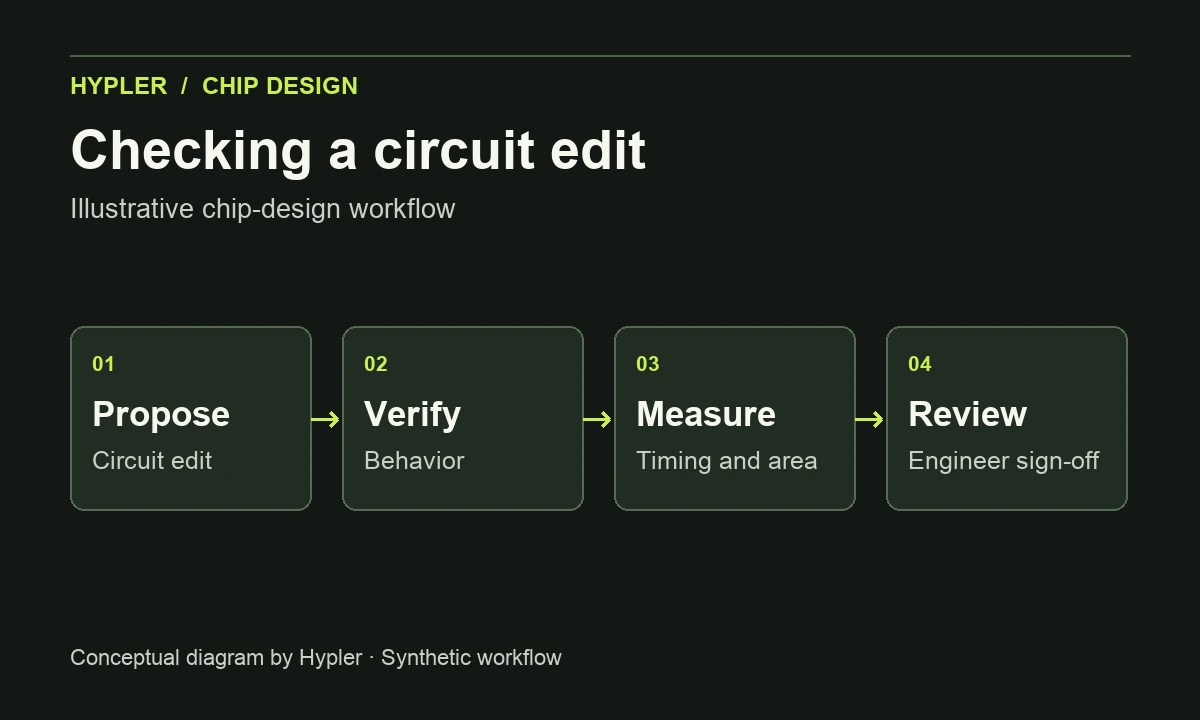
From circuit edits to hardware
Engineers can describe a circuit in code, then check whether another design implements the same behavior with less area, lower power or better timing. On November 18, OpenAI described how its models helped explore those changes on Jalapeño, its custom inference chip. The company estimates that model-proposed changes cut standard-cell area by about 13% in the vector unit and 10% in the matrix unit. It says the optimizations were demonstrated at silicon bring-up. Those estimates describe specific units.
OpenAI also reports up to 14% improvement against heavily optimized AMD GPU design baselines across work on power, performance and area. It says AMD included some edits in a design sent for manufacturing. OpenAI used Synopsys design tools to check circuit behavior and evaluate trade-offs. In September, OpenAI and Synopsys announced plans for a model specialized in electronic design automation. The announcement gives no finished-chip performance results for the AMD design.
Hypler analysis
A design team could put a model to work on a small arithmetic block and give it a fixed area budget and timing target. A proposed edit would go through behavioral comparison and synthesis. Engineers would compare the result with the existing design and decide which candidates merit physical-design and sign-off work. That process makes a proposal reproducible and keeps requirements visible.
OpenAI’s separate experiments with open RISC-V processors show why the requirements matter. It notes that generating a core from a written specification left room to omit features present in the original core. Strong throughput on the test workloads, by itself, cannot show how those omissions would affect a production part.
For U.S. semiconductor leadership, a plausible gain is more checked design iterations per engineering team. Measuring that gain requires the full workflow cost, including tool runs, rejected candidates, human review and sign-off. Time saved before synthesis is useful only if the team can still meet the constraints that govern fabrication.
Hypler analysis
Hypler’s view
The results illustrate a bounded role for models in proposing circuit changes that engineers can test against existing behavior and design constraints.
Terms and definitions
- Semiconductor
- A material and device technology used to build processors, memory, and other electronic components.
- Evaluation
- A repeatable method for measuring a system against defined quality, safety, or task criteria.
- Inference
- Using a trained model to produce an output from new input.
- NVIDIA frames AI-defined fabs around chip design and manufacturing
NVIDIA frames CUDA-X work with semiconductor partners around AI-enabled chip design and manufacturing, while early-access claims require bounded evidence.
- AWS announces Amazon Nova models in Bedrock
AWS announced Amazon Nova models in Bedrock across text, multimodal, image, and video tasks, with regional access and account configuration boundaries.
- Anthropic introduces Citations on the Claude API
Anthropic announced a Citations feature for the Claude API, designed to associate answers with source passages from supplied documents.

Original source
The article attributes technical and financial results to the primary source and identifies Hypler analysis separately. The supporting image is conceptual.